

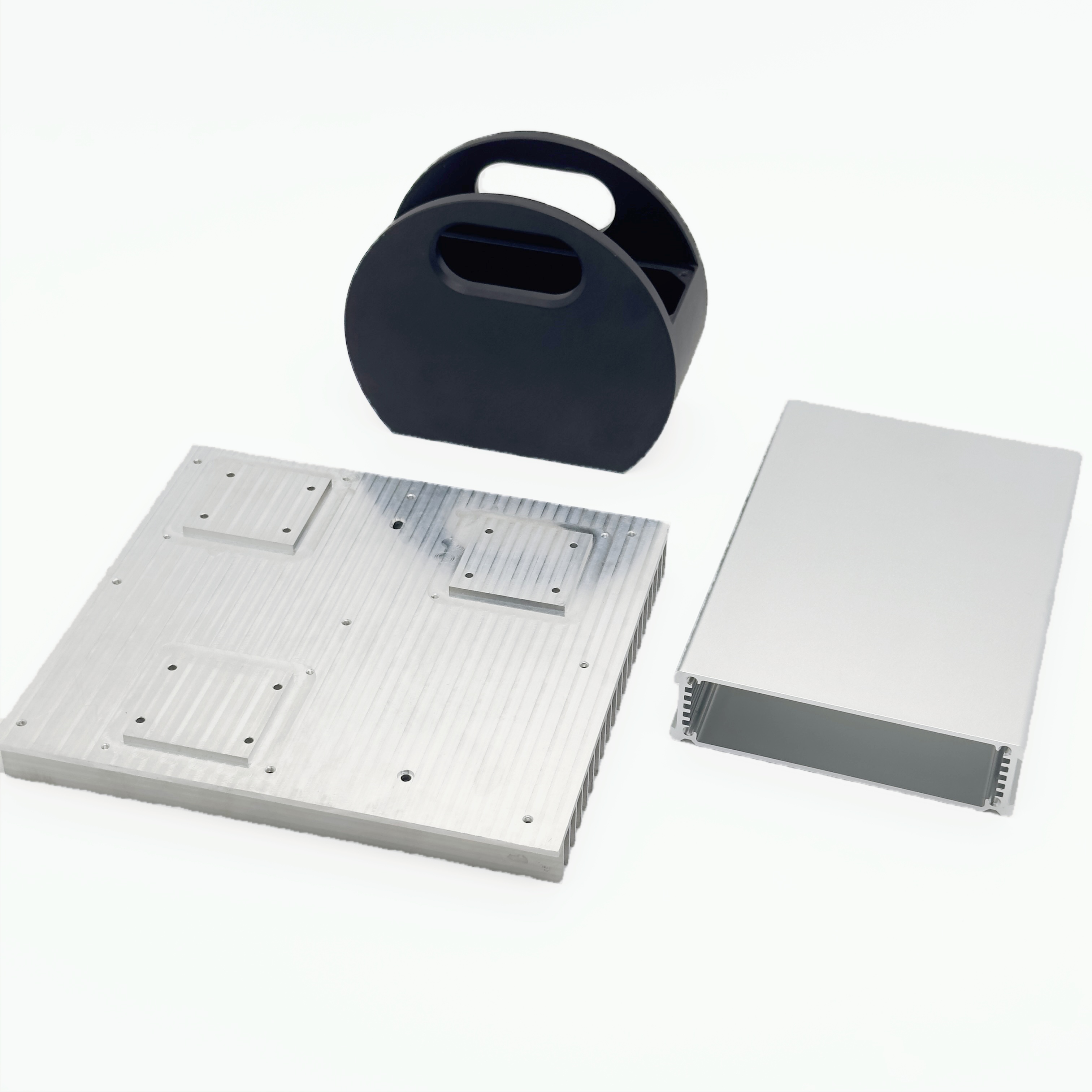
When a component needs a long, continuous profile with a consistent cross-section, custom metal extrusion can be a far more efficient route than machining the entire part from solid stock. Extruded profiles are used for structural sections, frames, rails, housings, heat sinks, channels, supports, and guides across industrial, automotive, construction, electronics, and automation applications.
The hard part is rarely deciding to use extrusion — it is deciding which extrusion. Engineers and buyers still have to settle the material, the profile geometry, the tooling strategy, the realistic tolerance, the production volume, and the secondary operations that turn a raw profile into a finished component.
This guide works through those decisions in order, and explains why custom metal extrusion is best understood as one step in a manufacturing sequence rather than a standalone answer.
What Is custom extrusion?
Extrusion forces material through a specially designed die to create a continuous profile with a defined cross-section. Aluminum is pushed through the die as a heated billet; plastics are typically melted and pumped through a die; other materials follow their own process requirements. In every case the defining characteristic is the same: the geometry is constant along the length.
That single property explains the economics. Once the die is made, the same profile can be produced repeatedly over long lengths and then cut into individual components, so the tooling investment is spread across every part and every metre produced.
Dies themselves come in different constructions depending on the section. Relatively simple solid profiles can run through a straightforward die, while hollow sections with internal cavities need a more complex die set. That difference is one of the main reasons profile complexity drives tooling cost. See custom extrusion for the process and material range, and extrusion manufacturing for custom metal and plastic profiles for a broader overview.
When Is Custom Extrusion the Right Manufacturing Process?
Part geometry should be the first consideration. Extrusion suits long components, continuous profiles, repeated cross-sections, structural rails, channels, frames, heat sinks, housings, guides, and profiles with integrated ribs or internal channels.
It is a poor fit for completely irregular 3D shapes, parts without a consistent cross-section, components dominated by complex end features, and very low-volume designs where the die investment cannot be justified. In those cases the profile would be doing almost none of the work, and machining or another process is usually the better answer.
A useful test is to ask whether one cross-section could be drawn and then repeated along the length. If the answer is yes, extrusion is worth evaluating; if the section has to change every few centimetres, the profile will not carry enough of the geometry to justify a die.
Common Applications of Custom Extrusion
Automotive
Structural profiles, rails, battery-related profiles, cooling components, mounting structures, and trim or support profiles, where consistent cross-sections and weight reduction matter.
Construction
Frames, rails, channels, window and door profiles, and structural sections — traditionally one of the largest extrusion markets because profiles repeat over long runs.
Electronics
Heat sinks, electronic housings, mounting profiles, and thermal management components, where integrated fins or channels are formed directly by the die.
Industrial Equipment
Machine frames, guides, rails, structural supports, and protective profiles used to build equipment structures from standard or custom sections. Where the same frame member is repeated many times, a custom profile can often replace a welded fabrication at lower cost and better consistency.
Robotics and Automation
Linear guide structures, frames, mounting profiles, covers, and support structures — an area where modular framed structures are common. SUNPREC lists robotics and automation among the industries it serves.
How to Design a Custom Extrusion Profile
Profile design determines whether a die can be built economically and whether the profile will run consistently. Six principles cover most of the risk.
Uniform Cross-Section
Extrusion works best when the cross-section stays consistent along the length. Features that must vary — a local boss, an angled end, a stepped section — are generally added afterwards by machining.
Wall Thickness
Avoid extreme variation between thick and thin walls. Large differences affect how material flows through the die and can compromise dimensional stability and surface quality.
Ribs and Channels
Well-designed ribs, channels, and internal cavities add strength and stiffness while keeping weight low — one of the main reasons extrusion competes with solid machined components.
Symmetry
Balanced, reasonably symmetric profiles generally run more stably than heavily asymmetric ones, which are more prone to distortion as the material cools.
Corners and Radii
Avoid excessively sharp corners. Sensible radii improve material flow, extend tool life, and produce a cleaner profile — and they reduce the chance of cracking during forming.
Hollow Sections
Hollow profiles reduce weight, improve structural efficiency, and can integrate channels or conduits directly into the section. They do, however, require more complex tooling, so the design should be reviewed with the die maker early.
Aluminum Extrusion vs Plastic Extrusion
| Factor | Aluminum Extrusion | Plastic Extrusion |
|---|---|---|
| Typical strengths | Structural strength, thermal performance | Lightweight, insulation, flexibility |
| Common applications | Frames, rails, heat sinks | Covers, seals, channels, insulation profiles |
| Thermal conductivity | High | Generally low |
| Electrical insulation | Limited | Often strong |
| Weight | Lightweight | Very lightweight |
| surface finishing | Many options | Depends on polymer |
| Structural applications | Strong | Depends on material |
| Custom profile capability | High | High |
Neither material is universally better. Aluminum wins where the profile must carry load, dissipate heat, or take a durable metallic finish. Plastics win where electrical insulation, chemical resistance, low weight, or low friction matter more than stiffness. The decision is an application decision, not a quality ranking.
A practical order of work is to choose the material by function first — structure and thermal behaviour point toward aluminum, while insulation and chemical resistance point toward plastic — and only then compare cost, finishing, and secondary operations.
How to Choose the Right Extrusion Material
Aluminum
Aluminum offers low weight, a good strength-to-weight ratio, corrosion resistance, high thermal conductivity, good machinability, and broad surface finishing options — which is why it dominates structural and thermal profiles.
Plastics
Extruded plastics bring electrical insulation, chemical resistance, light weight, flexibility, low friction, and low cost, and suit covers, seals, channels, and insulation profiles.
Material selection should be driven by the mechanical requirements, service temperature, chemical exposure, weight targets, thermal and electrical requirements, required surface appearance, and cost — reviewed together rather than one at a time.
How Extrusion Tooling Affects Cost and Production
Custom extrusion generally requires a custom die, and the die is the main upfront investment. Its cost is driven by die design and profile complexity, the material being extruded, the tolerances required, the production volume, and expected tool life.
Because that investment is fixed, its effect per part falls as volume rises. Extrusion therefore becomes particularly attractive for repeated production of the same profile — but there is no universal break-even quantity. Whether the die pays off depends on the specific profile, the material, the remaining secondary operations, and the total quantity required.
Extrusion Tolerances and Dimensional Accuracy
Extrusion tolerance depends on the material, profile geometry, wall thickness, die design, extrusion parameters, cooling, cutting, and the measurement method used. A thin, complex wall is a different tolerance problem from a simple heavy section.
Not every dimension should be assigned an extremely tight tolerance. The drawing should identify the critical dimensions — the ones that affect assembly, sealing, or fit — and let the rest follow practical defaults, because over-tolerance is a cost driver without a functional benefit. It also helps to specify tolerances per dimension and per direction: cross-sectional size, wall thickness, straightness, twist, and cut length all behave differently, and the drawing should make clear which of them are functional. SUNPREC's website presents custom extrusion consistency and dimensional accuracy around ±0.2 mm; this is the capability stated for its extrusion process, not a guaranteed tolerance for every extruded part.
Secondary Operations After Extrusion
Extrusion is normally a primary forming process: it creates the profile, not the finished component. The application-specific features are added afterwards through cutting, cnc machining, drilling, tapping, milling, notching, bending where applicable, deburring, surface finishing, and assembly.
A typical sequence for an extruded aluminum component looks like this: extrude the profile; cut it to the required length; CNC machine the mounting holes; drill and tap the threads; deburr; apply anodizing or powder coating; then inspect and package. Because the profile already carries most of the geometry, the machining step is usually short — which is exactly why the combination is cost-effective. Cutting and machining tolerances can be held more tightly than extrusion tolerances, so critical features are best located on machined surfaces rather than on the as-extruded section. See this overview of precision metal profiles and custom extrusion solutions for how profile design and downstream operations interact.
Extrusion vs CNC Machining
| Factor | Custom Extrusion | CNC Machining |
|---|---|---|
| Starting material | Billet or pellets, depending on process | Solid stock |
| Best suited for | Continuous profiles | Discrete 3D parts |
| Tooling | Custom die required | Usually minimal dedicated tooling |
| Material utilization | Generally efficient for profiles | More material removed |
| Long profiles | Excellent | Often less efficient |
| Complex 3D geometry | Limited by the profile | Highly flexible |
| Prototype flexibility | Depends on tooling | Excellent |
| High-volume repeated profiles | Highly suitable | May be less efficient |
| Secondary machining | Often required | Can be the primary process |
Extrusion and CNC machining are not competing processes — they solve different halves of the same problem. A common manufacturing strategy is extrusion, then cutting, then CNC machining, then surface finishing. Multi-axis capability extends the same logic to angled holes, contoured cuts, and precision interfaces on the profile; see how multi-axis machining expands design freedom.
When Should You Choose Extrusion Instead of CNC Machining?
Choose Extrusion When
- The cross-section remains consistent along the length.
- The component is long relative to its section.
- Sufficient quantities are required to justify the die.
- Material efficiency matters.
- Integrated channels or ribs are useful.
- A custom profile can reduce downstream machining.
Choose CNC Machining When
- The component has complex 3D geometry.
- The cross-section changes significantly along the part.
- Tight localized tolerances are required.
- Complex pockets or features dominate the design.
- Volume is too low to justify extrusion tooling.
Consider Both When
- Extrusion can efficiently create the main profile.
- CNC machining is still needed for holes, threads, slots, or precision interfaces.
How Production Volume Affects Extrusion Economics
Prototype
Tooling cost is a significant consideration at this stage, and CNC machining is often more flexible while the design is still being validated.
Small Batch
The decision should balance tooling, profile complexity, quantity, material, and secondary operations together rather than on tooling alone.
High Volume
Extrusion tends to become attractive because the die cost is distributed across more parts, continuous production is efficient, material utilization is favorable, and repeated profiles can be produced consistently over long runs.
Surface Finishing for Extruded Parts
Extruded parts can be finished with anodizing, powder coating, painting, electrophoresis, polishing, and other applicable treatments. The finish affects corrosion resistance, appearance, wear resistance, surface hardness, and electrical properties, so it should be decided during material and profile selection rather than after the part is cut. Anodizing, for example, is well matched to aluminum profiles, while powder coating tends to suit parts where colour and coverage matter more than a metallic surface. See surface finishing and this guide to extrusion and surface finishing for how the two interact.
How to Choose a custom extrusion manufacturer
A supplier that only extrudes will hand the profile off at every downstream step. A supplier that also machines and finishes can hold the whole sequence together, which usually shortens lead time and reduces the tolerance risk that builds up between separate operations.
Material Capability
Can the supplier handle aluminum and plastic profiles, and copper, steel, or specialty materials where the application requires them?
Tooling Capability
Can they design extrusion dies, optimize the profile geometry for manufacturability, manufacture tooling, and modify it when the design changes?
Secondary Operations
Cutting, CNC machining, drilling, tapping, and surface finishing in-house reduce handling, lead time, and the risk of tolerance loss between vendors.
Quality Control
Look for dimensional inspection, material verification, surface inspection, process control, and final inspection backed by documentation.
Production Scalability
Confirm that prototype, small batch, large batch, and mass production can all be supported, so the program does not have to change suppliers as it scales.
Why Choose SUNPREC for Custom Extrusion?
SUNPREC is a one-stop precision metal parts manufacturer. Its website presents custom aluminum and plastic profile extrusion, including complex cross-sections, custom tooling, precision cutting, and secondary operations, and states that its extrusion work serves construction, automotive, industrial, and consumer applications. The site also highlights high-precision tooling, surface treatments, consistent quality, and prototype-to-mass-production support.
Because extrusion does not have to be treated as an isolated process, SUNPREC can combine it with CNC machining, cnc turning, surface finishing, die casting, investment casting, and sheet metal fabrication within one supplier and one quality system, supported by documented manufacturing capability. The extrusion dimensional capability shown on SUNPREC's website is around ±0.2 mm; this describes the stated extrusion capability and should not be read as a guaranteed tolerance for every extruded part, since achievable tolerance depends on material, profile geometry, wall thickness, die design, process parameters, and inspection method.
Conclusion
Custom extrusion can be an efficient manufacturing solution when a component requires a continuous, repeated cross-sectional profile. The right extrusion strategy depends on profile geometry, material, wall thickness, tolerance, tooling, production volume, secondary operations, surface finish, and total cost — considered together rather than one at a time.
In short: extrusion suits long, repeated profiles; CNC machining is more flexible for complex 3D discrete components. For many real-world products, the most practical answer is a sequence of extrusion, CNC machining, and surface finishing.
Developing a Custom Extrusion Profile?
Send SUNPREC your drawings, dimensions, material requirements, tolerance specifications, surface finish, and estimated production volume. Our engineering team will review the requirements and recommend a suitable extrusion and manufacturing approach.
Request a Quote from SUNPREC →FAQ
1. What is custom metal extrusion?
It is the process of pushing metal — most often aluminum — through a custom die to create a continuous profile with a defined cross-section. The profile is produced in long lengths and then cut, machined, and finished into individual components.
2. What materials can be used for custom extrusion?
Aluminum is the most common metal, and plastics are widely extruded for covers, seals, channels, and insulation profiles. Copper, steel, and specialty alloys are used where the application requires their specific properties.
3. Is aluminum extrusion suitable for high-volume production?
Yes. Once the die is made, the same profile can be produced repeatedly, and continuous production with favorable material utilization suits high volumes. The die cost is simply spread over more parts as quantity rises.
4. Can extruded profiles be CNC machined?
Yes, and they usually are. Extrusion creates the main profile; CNC machining adds holes, threads, slots, cutouts, and precision interfaces that a continuous section cannot provide.
5. How do I choose the right custom extrusion manufacturer?
Check material and die-design capability, in-house secondary operations such as cutting and CNC machining, surface finishing, quality control and inspection, and the ability to support the project from prototype through mass production.